




Get Your Free Custom Freight Quote Today
Share your requirements with us, and our experts will assess your shipping needs to deliver a cost-effective solution
"*" indicates required fields
Interstate freight documents are easier to manage when you know what your freight team needs before pickup. In our experience at AS Freight, most paperwork issues are not caused by complex forms. They usually come down to missing receiver details, unclear freight measurements, no booking reference, or delivery notes that were not passed on.
It helps us quote the job properly, book the right transport option, avoid preventable pickup delays, and confirm delivery once the freight arrives.
When you book interstate freight with AS Freight, we need enough detail to understand what is moving, where it is going, and how it needs to be handled.
For a standard business freight booking, this usually means sender details, receiver details, freight description, total weight, dimensions, pallet count, item count, pickup notes, delivery notes, and any customer references. These details help us match the freight to a suitable carrier and reduce avoidable back-and-forth before pickup.
This is even more important for interstate freight because goods may pass through more than one depot, vehicle, or handling point before final delivery. The clearer the booking is at the start, the easier it is for each person in the network to handle the job correctly.
Consignment details are the working record for the shipment. They should show the pickup address, delivery address, freight type, item count, pallet count, total weight, dimensions, references, and any site instructions.
For example, “2 pallets, 280 kg total, 120 cm x 120 cm x 140 cm each, delivery to a warehouse with forklift access” is far more useful than “2 pallets to Sydney.” The first version helps the freight team quote, book, and plan the movement. The second version creates follow-up questions before the freight can move with confidence.
If the freight is tall, fragile, heavy, awkward, or cannot be stacked, say so at booking. These notes help avoid problems at pickup, depot handling, or delivery.

Receiver information is one of the easiest areas to get wrong. A missing unit number, old contact name, wrong phone number, or incomplete suburb can stop delivery even when the freight has arrived in the right city.
Before booking, check the receiver’s business name, full street address, contact person, phone number, opening hours, and unloading access. If the delivery address is a shopping centre, construction site, mine site, warehouse complex, or shared loading dock, add clear notes.
A driver should not have to guess which gate to use, who to call, or whether a forklift is available. These details reduce failed delivery attempts and help the receiver prepare for the freight.
After the booking is made, keep your confirmation and reference numbers handy. These may include the booking number, consignment number, purchase order, sales order, invoice number, or customer job number.
Good references matter when you or your customer asks, “Where is this freight?” They also help when checking delivery status or requesting proof of delivery. If a customer uses one reference and your warehouse uses another, include both at the start.
Without clear references, the freight team may need to search by sender, receiver, suburb, or date. That can slow down answers, especially when several shipments are moving at the same time.
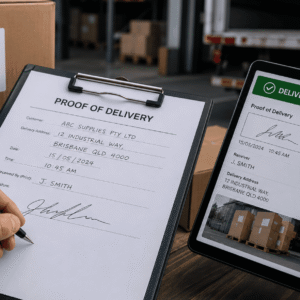
Proof of delivery, often called POD, is the record that shows freight was delivered. Depending on the carrier and delivery process, it may include a receiver signature, delivery scan, timestamp, driver record, photo and or delivery note.
For shippers, the practical lesson is simple: POD is easier to confirm when the booking details are accurate from the start.
If the receiver’s name, address, or reference number does not match the booking, the POD may take longer to locate or verify. Making sure POD’s are dated correctly regarding collection and delivery dates and times can save a lot of time.
Most document-related hold-ups happen before pickup, at delivery, or when POD is requested.
Before pickup, missing weight, dimensions, or freight type can delay quoting. At pickup, unclear access notes can cause issues if a truck arrives and the site is not ready. At delivery, incorrect receiver details can lead to missed delivery, extra contact, or freight being held while the correct details are checked.
After delivery, missing references can slow down POD requests. This becomes frustrating when your customer wants confirmation quickly, and the job has to be searched manually.
Before booking your next interstate freight job, check that you have the full sender and receiver details, the correct pickup and delivery addresses, the freight type, pallet count, item count, weight, and dimensions.
You should also include site access notes, such as forklift access, dock access, tailgate needs, time slots, booking references, order numbers, invoice numbers, and delivery instructions for the receiver.
If your customer needs delivery proof quickly, tell the freight team early. That way, POD expectations are clear before the freight moves.
If you are unsure what details to provide, our team can help you prepare the right information before booking interstate freight across Australia.

At AS Freight, we work with businesses that need freight moved safely and with less guesswork. Our job is to help you get the right details into the booking, match the freight with a suitable transport option, and keep communication clear from pickup through to delivery.
Detailed paperwork and communication support better service. It gives your freight team, carrier, warehouse, and receiver the same information, which helps avoid rework and keeps your shipment moving.
Most shippers need sender details, receiver details, consignment details, freight measurements, delivery instructions, references, and booking confirmation. You should also keep any POD records linked to the same shipment.
No. A consignment note records the shipment details at booking or pickup. Proof of delivery confirms the freight reached the receiver.
Provide pickup and delivery suburbs, freight description, item count, pallet count, total weight, dimensions, and any site access needs. Clear details help reduce quote changes after booking.
The freight may be delayed, held, or sent for further checks before delivery can be completed. Wrong receiver details can also make POD confirmation harder after delivery.
POD is usually requested through your freight provider using the booking, consignment, or customer reference number. Keeping your references clear helps the team find the correct delivery paperwork faster.
Read our Blog

Share your requirements with us, and our experts will assess your shipping needs to deliver a cost-effective solution
"*" indicates required fields

