




Get Your Free Custom Freight Quote Today
Share your requirements with us, and our experts will assess your shipping needs to deliver a cost-effective solution
"*" indicates required fields
Sending your first pallet across state lines can feel more complicated than it should be. Between pallet sizes, weight limits, and delivery options, small business owners often overpay for a service that does not fit their freight. Knowing how to ship a pallet interstate in Australia really comes down to a handful of steps, and once you know them, the process is genuinely simple.
Most freight moved within Australia sits on the Australian standard pallet, measuring 1165mm by 1165mm under AS 4068. This square footprint suits local rail containers, truck decks, and racking systems, so it is the safest default if you are unsure what to use. The pallet itself carries weight too, with a standard timber CHEP pallet weighing around 38 kilograms empty, which matters once you calculate total shipment weight.
Guessing your pallet’s weight or height is one of the quickest ways to end up with a quote that does not match the final invoice. Freight is charged on whichever is greater: actual weight or cubic weight, which reflects the space your pallet takes up rather than just its mass. Using a commonly applied road freight factor of 250kg per cubic metre as an example, a pallet on the 1165mm by 1165mm standard footprint stacked 1.2 metres high works out to roughly 1.63 cubic metres, converting to a cubic weight of about 407kg even if the goods themselves weigh far less.
Overhang past the pallet’s edge adds to this cubic volume too, so measure the full stacked height, including any overhang, before requesting pricing. Most carriers work off a similar template but it’s always best to check with every carrier which method they use to ensure quoting accuracy before a job gets underway.
Interstate transport involves multiple handling points, so how you pack your pallet matters as much as which carrier you choose. National road transport guidelines make it clear that goods should be packed onto sound pallets, secured so nothing shifts, and labelled with weight details. One of the most common reasons a carrier refuses a pallet at pickup is overhang, where cartons or wrapping extend past the edge and risk catching on other freight during transit. Shrink wrap, strapping, and corner protection keep goods intact and within the required footprint.

Once your pallet is measured, weighed, and packed, request a quote. A reliable pallet transport provider will ask for pickup and delivery locations, dimensions, weight, and pallet count. The more precise this is, the more accurate your quote, with fewer surprises once your goods are moving.
Not every shipment needs the same transport type. Full Truck Load suits larger, high-volume freight filling most of a vehicle, while Less Than Truck Load is cost-effective for smaller shipments sharing space with other freight. If timing matters, ask about timeslot deliveries so your pallet arrives within a set window.
Before the allocated pickup day, confirm your pallet is labelled with sender and receiver details and sits somewhere accessible for the driver. Having this ready avoids delays and keeps your freight moving from the first leg of the journey.
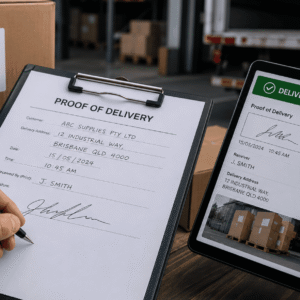
Once your pallet is on the road, tracking gives you visibility over where it is and when it will arrive. A good pallet transport service provides live updates so you can plan around delivery instead of guessing. When it arrives, check it against your paperwork and inspect for damage before signing off.
Ready to send your next pallet interstate? Our team can arrange a quote tailored to your freight.
Cost depends on weight, dimensions, distance, and delivery speed. Accurate measurements before you request a quote are the best way to avoid unexpected charges.
The Australian standard pallet measures 1165mm by 1165mm under AS 4068, suiting most local racking, trucks, and rail containers. Other sizes exist for specific industries, but this is the safest default.
Wrap goods securely, use strapping or corner protection, and keep everything within the pallet’s footprint. Overhanging cartons are a common reason carriers refuse a pickup, so check nothing extends past the edge.
Full Truck Load suits large shipments filling most of a vehicle, while Less Than Truck Load is cost-effective for smaller pallets sharing space with other freight. The right choice depends on shipment size and budget.
Transit time depends on the distance between states, the delivery option chosen, and site access at both ends. Timeslot deliveries can narrow the arrival window down further if a specific delivery time matters to your business.
Read our Blog

Share your requirements with us, and our experts will assess your shipping needs to deliver a cost-effective solution
"*" indicates required fields

